
The Steel Challenge Start Position, With the Numbers
There are two Steel Challenge start positions, not one - and the aiming flag for rimfire and carbine has published dimensions with exact numbers. Plus creeping vs. false start, and what each costs.
On this page
The short version
There are two Steel Challenge start positions, not one. Centerfire handgun is a surrender start with the gun holstered. Rimfire pistol, rimfire rifle, rimfire revolver and PCC start pointed in at an aiming flag — a defined target, at a defined distance and height. That second position often gets described loosely as “low ready”; the rulebook gives it exact numbers, and they are below.
Position one: centerfire handgun — surrender
Standing inside the box, gun loaded and holstered. Hands in the surrender position: wrists and hands above the shoulders, fully visible from behind (rule 8.2.2).
“Fully visible from behind” is the part shooters get corrected on. The RO is standing behind you. If your hands are tucked forward of your ears or your wrists have dropped below shoulder line, you will be told to fix it before the beep — and if you fix it at the beep, that is creeping.
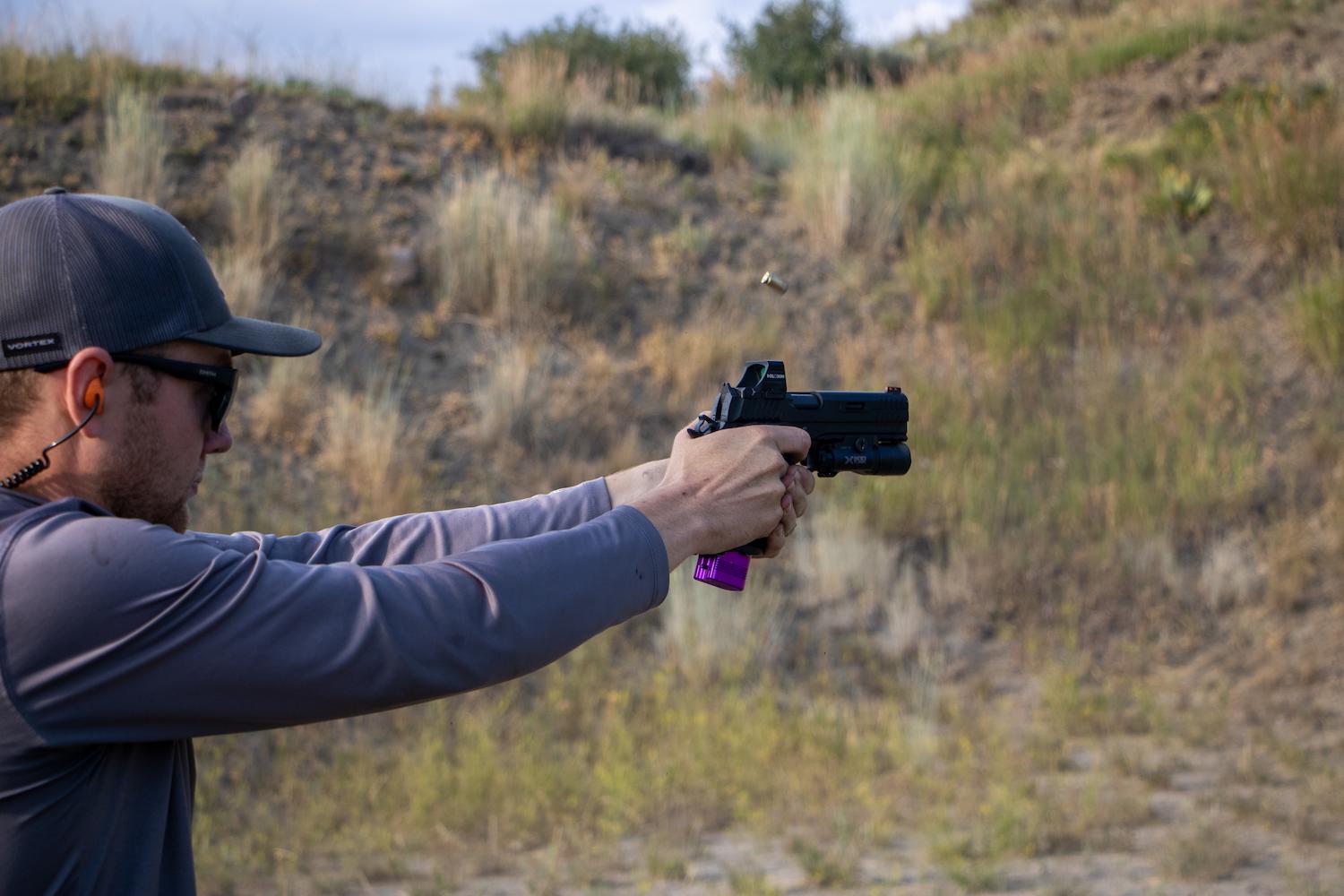
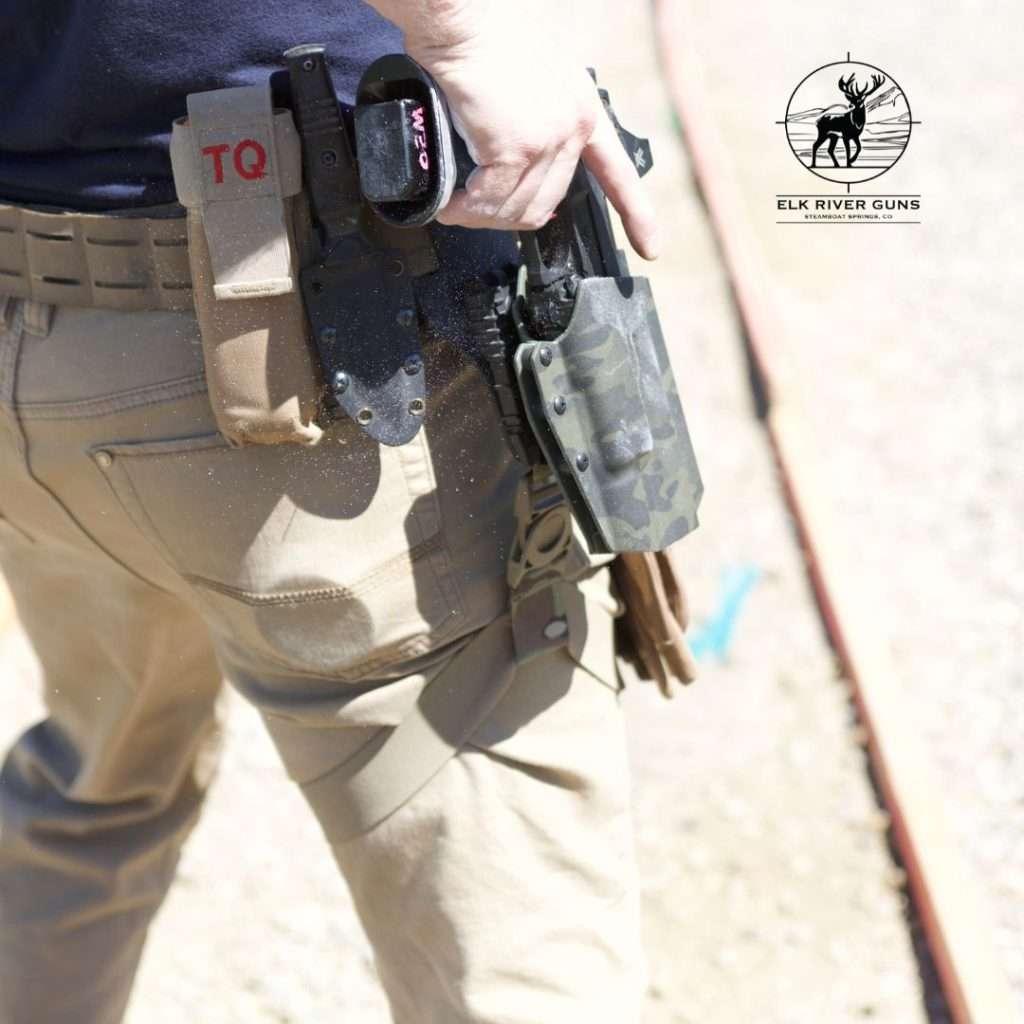
Everything from the beep to the first hit is one repeatable motion — which is exactly why the position you start from has to be repeatable too.
Position two: rimfire and carbine — pointed in at the flag
The rulebook is specific about this one. Rule 8.2.3:
You point the muzzle at that flag. Finger off the trigger and outside the trigger guard. The hammer may be cocked and the safety may be off, if the gun has those.
That is not “low ready” in the defensive-shooting sense, and the difference matters for practice. A flag 10 feet out at roughly knee height puts the muzzle down at a specific, repeatable angle. Your first move is a defined arc from that angle to the first plate — every time. If you dry-fire from a vague low ready you are training a start you will never actually use.
Creeping, and the false start that is not a penalty
These two get confused constantly, and they have very different consequences.
- Creeping — moving your hands toward the gun, or raising the gun from the start position, at the start signal. That is a 3-second procedural penalty (10.1.1). It counts as creeping because you began the movement before the beep and finished it on the beep.
- False start — moving before the start signal. The RO stops you as soon as possible and restarts you once the stage is reset (10.1.1.1). No penalty.
So the expensive version is the subtle one. Jumping the gun outright gets you a do-over; anticipating the beep by a fraction and being caught mid-motion when it sounds costs you three seconds on that string. The rest of the penalty schedule is on our scoring and penalties page.
Where you stand: the box
The start position is standing within the box, and when you are ready you assume the required position — that is how you tell the RO you are ready (8.2.1). Seven of the eight stages use a single 3′×3′ box. Showdown uses two, and Outer Limits uses three 4′×4′ boxes.
Two things about the box that cost time and points:
- Standing on the raised edge of the box is not a fault. A foot fault happens only when your foot touches the ground outside the box (10.1.2.1).
- A fault is 3 seconds per shot fired while faulting — not 3 seconds for the string (10.1.2). Drift out on a wide transition and keep shooting and it compounds fast.
As of the March 1, 2026 rulebook, boxes have a construction standard too: fixed firmly in place, at least 0.75 inch thick on hard surfaces and 1.5 inches or more on softer ground (2.2.1). If your club is still using flat tape on gravel, that changed this year — along with several other things in the 2026 edition.
What to actually practice
- Build the flag. Nine inches wide, 10 feet out, 18–24 inches high. Cardboard on a stick works. Now every rep starts where the match starts.
- Practice the still. Most creeping penalties come from shooters who cannot hold a position for an unpredictable two to four seconds. Have someone give you random beeps while you hold surrender.
- Split the draw from the run. Time yourself from beep to first hit only. Then time first hit to stop plate. Nearly everyone below A class finds the second number is where the seconds are — and the peak times page turns that into a par time you can actually set.
A holster you can draw from consistently matters more here than almost anything else, because the centerfire start position puts your hands as far from the gun as the rules allow. Rimfire and carbine shooters skip the holster entirely and start from the case.
How current this page is
Written against the 2026-03 rulebook, effective March 1, 2026, and checked September 8, 2026. Every rule number is printed above so you can check any line against the rulebook yourself — that is what it is for. The rulebook itself is at scsa.org/rules.
We review this page against the current rulebook on a regular cycle and update it when a rule moves, re-stamping the date at the top. If a number here no longer matches the rulebook, tell us at [email protected] and we will verify it against the source and correct it on the next review.
Sources
SCSA Competition Rules, edition 2026-03, effective March 1, 2026 — rules 8.2.1, 8.2.2, 8.2.3, 8.2.4, 10.1.1, 10.1.1.1, 10.1.2, 10.1.2.1, 2.2.1. Retrieved September 8, 2026. The Steel Challenge Shooting Association and your match director are the authority.
 Steel Challenge Roundabout (SC-108): Layout, Dimensions and Strategy
Sep 9, 2026
Steel Challenge Roundabout (SC-108): Layout, Dimensions and Strategy
Sep 9, 2026
 Steel Challenge Speed Option (SC-107): Layout, Dimensions and Strategy
Sep 9, 2026
Steel Challenge Speed Option (SC-107): Layout, Dimensions and Strategy
Sep 9, 2026
 Steel Challenge Pendulum (SC-106): Layout, Dimensions and Strategy
Sep 9, 2026
Steel Challenge Pendulum (SC-106): Layout, Dimensions and Strategy
Sep 9, 2026