
Steel Challenge Scoring and Penalties: The Rules People Get Wrong
The 30-second ceiling, what a miss actually costs, why the timer never backs up, and the appeal window shooters forfeit by accident. Every rule number cited so you can check it yourself.
On this page
- How a stage is scored
- The penalties, and what they actually cost
- The 30-second ceiling — the rule people argue about
- Edge hits, appeals, and the part shooters forfeit by accident
- How the timer works, and why it does not “back up”
- The Outer Limits exceptions
- Showdown’s box rotation
- How current this page is
The one-sentence version
Your time is your score, lowest wins, and the single most misunderstood rule in the sport is that no string can ever score worse than 30 seconds no matter how badly it goes.
How a stage is scored
Every one of the eight official stages has exactly five targets: four standard plates and one stop plate. Not six, not seven — five, on every stage, always. You shoot five strings on the stage (four on Outer Limits), and the clock on each string starts at the beep and stops on your last shot.
Your worst string on each stage is thrown out. That is the mechanic that makes Steel Challenge forgiving of one disaster and unforgiving of consistent mediocrity: one blown run costs you nothing, two blown runs cost you the stage.
You may fire as many rounds as you like on a string. There is no round limit and no reload requirement. Miss a plate, shoot it again — the only thing that matters is that every standard plate is down before you hit the stop plate.
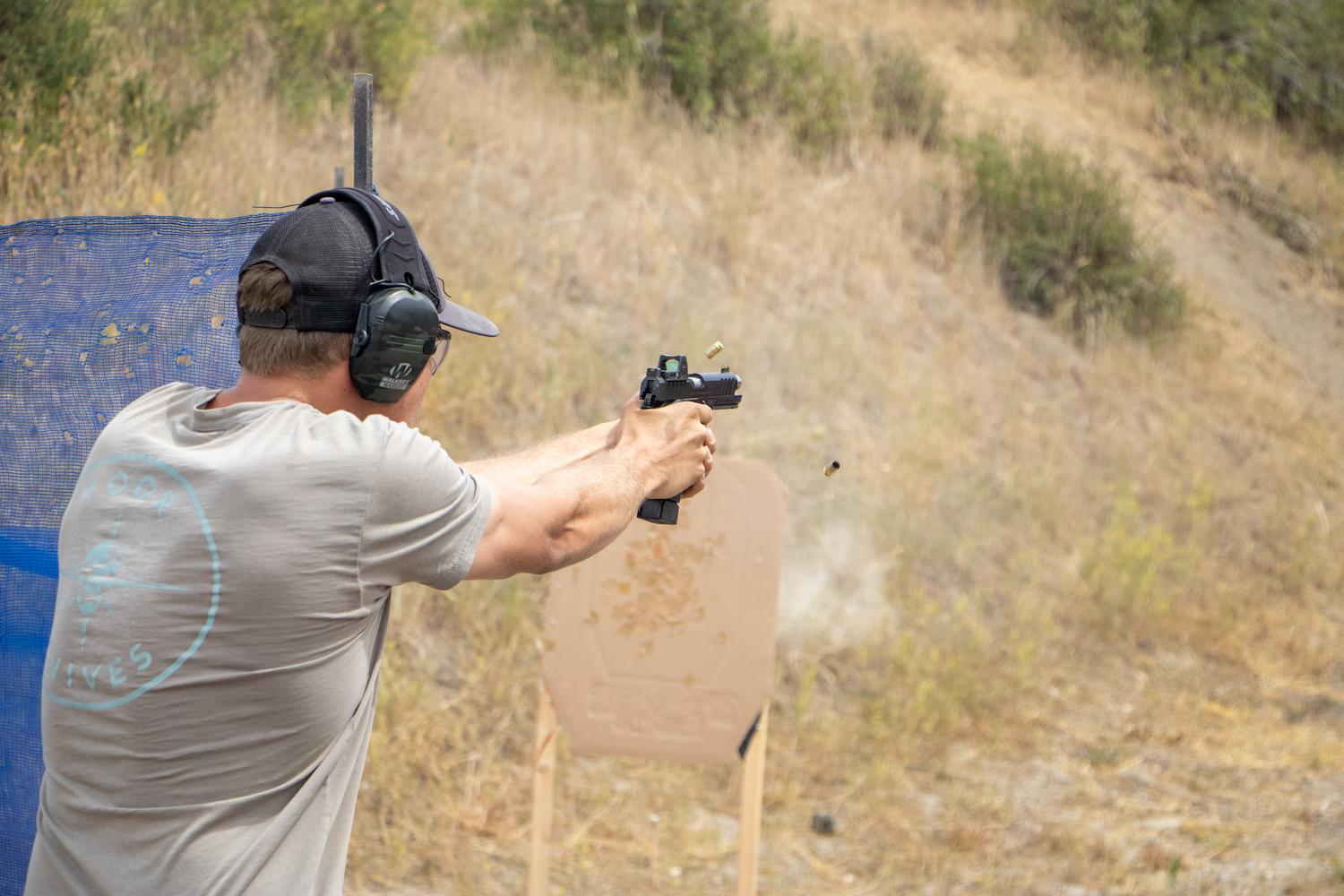
The clock stops on your last shot — not on the shot that drops the stop plate. That distinction costs people real time.
The penalties, and what they actually cost
| Situation | Penalty | Rule |
|---|---|---|
| A standard plate not hit before the stop plate | +3 seconds per plate | 9.3 |
| Stop plate never hit | String scores 30 seconds | 9.4 |
| Creeping — moving hands to the gun or lifting it at the start signal | +3 seconds | 10.1.1 |
| Foot fault — touching the ground outside the box while firing | +3 seconds per shot | 10.1.2 |
| Outer Limits: hitting a target from the wrong box | +3 seconds per occurrence | 10.1.3 |
| Any other procedural error | +3 seconds per occurrence | 10.1.4 |
| Improper movement, or failing to move where required | +4 seconds per string | 10.1.4.1 |
| Coaching at a Level II or higher match | +3 seconds — to both the coach and the shooter | 10.1.4.2 |
The 30-second ceiling — the rule people argue about
Maximum time for a string is 30 seconds. Any hits after that do not count. And then the rule that settles the argument at every club match:
So a string where you leave three plates standing and never find the stop plate scores 30 seconds — not 30 plus nine in misses. This has a real strategic consequence: on a string that has already fallen apart, there is no additional cost to trying to salvage it. There is also no benefit to giving up early, because you cannot score better than the clock either.
The flip side is the one that catches new shooters. If you never hit the stop plate, that string is 30 seconds — and 30 seconds is roughly three to four times a competent stage aggregate in most divisions. One un-hit stop plate is usually the single most expensive mistake available to you in the whole match. If you have ever heard that the stop plate is the only plate you really have to hit, rule 9.4 is the reason that is worth ignoring.
It also has a classification consequence people miss: a stage where every string defaults to 30 seconds is treated as a DNF and drops out of your classification math entirely. The peak times page walks through how that calculation works.
Edge hits, appeals, and the part shooters forfeit by accident
- An edge hit is a hit. If the bullet left a clear mark on the edge or the face of the plate, it scores. No discernible mark, no hit (9.3.2).
- The RO must tell you about a miss at the end of the string, and it is your job to appeal it right then. The RO goes downrange and inspects the plate (9.3.1).
- Once the next string has started, the appeal window is closed. Permanently. You can escalate to the Range Master before that, and the Range Master’s call is final (9.3.3).
That last one costs people places every season. If you think a plate was hit, say so before you load for the next string.
How the timer works, and why it does not “back up”
Steel Challenge uses sound-actuated timers. The timer hears shots; it does not see plates. Your time stops on the last shot fired — not on the shot that hit the stop plate.
The rulebook is explicit that timers will not be backed up for extra hits on the stop plate or shots fired after it (9.2.2). Double-tapping the stop plate out of habit adds real time to your run, every single string. It is one of the cheapest fixes available to a new shooter.
The Outer Limits exceptions
Outer Limits (SC-104) is the only stage that behaves differently, in three ways:
- Four strings, best three counted — not five and four.
- Designated targets must be engaged from designated boxes. Hitting a plate from the wrong box scores it as a miss, and each occurrence is a 3-second procedural.
- You are allowed to fix it. If you leave a box, realize you missed or shot out of sequence, and return to that box and shoot it correctly before hitting the stop plate, there is no penalty. Once the stop plate goes down, the clock stops and every penalty stands.
Showdown’s box rotation
Showdown (SC-102) has two shooting boxes. You must shoot three strings from one box and two from the other, in any order. Fail to rotate after three strings and you are required to reshoot — and only the reshoot time counts toward your score.
Every rule above is enforced by a shot timer and read off a painted plate. If you want to practice against the same standard at home, those are the two things worth owning — along with enough ammunition to make the reps count.
How current this page is
Written against the 2026-03 rulebook, effective March 1, 2026, and checked September 8, 2026. Every rule number is printed above so you can verify any line of this page against the rulebook yourself — which is the point. The rulebook is at scsa.org/rules.
Rules get amended between editions. We review this page against the current rulebook on a regular cycle and update it when a rule moves, re-stamping the date at the top when we do. If a rule number here no longer matches the rulebook, tell us at [email protected] and we will verify and correct it on the next review.
Sources
SCSA Competition Rules, edition 2026-03, effective March 1, 2026 — Chapter 9 (Scoring) and Chapter 10 (Penalties), plus rules 8.2.4 and 9.2.2. Retrieved September 8, 2026. The rulebook, your Range Master and your match director are the authority — not us. The Steel Challenge Shooting Association runs the sport.
 Steel Challenge Roundabout (SC-108): Layout, Dimensions and Strategy
Sep 9, 2026
Steel Challenge Roundabout (SC-108): Layout, Dimensions and Strategy
Sep 9, 2026
 Steel Challenge Speed Option (SC-107): Layout, Dimensions and Strategy
Sep 9, 2026
Steel Challenge Speed Option (SC-107): Layout, Dimensions and Strategy
Sep 9, 2026
 Steel Challenge Pendulum (SC-106): Layout, Dimensions and Strategy
Sep 9, 2026
Steel Challenge Pendulum (SC-106): Layout, Dimensions and Strategy
Sep 9, 2026