
Steel Challenge Smoke & Hope (SC-103): Layout, Dimensions and Strategy
The fastest stage in Steel Challenge, with every official dimension, current peak times, the per-string par they work out to, and why the name is a warning.
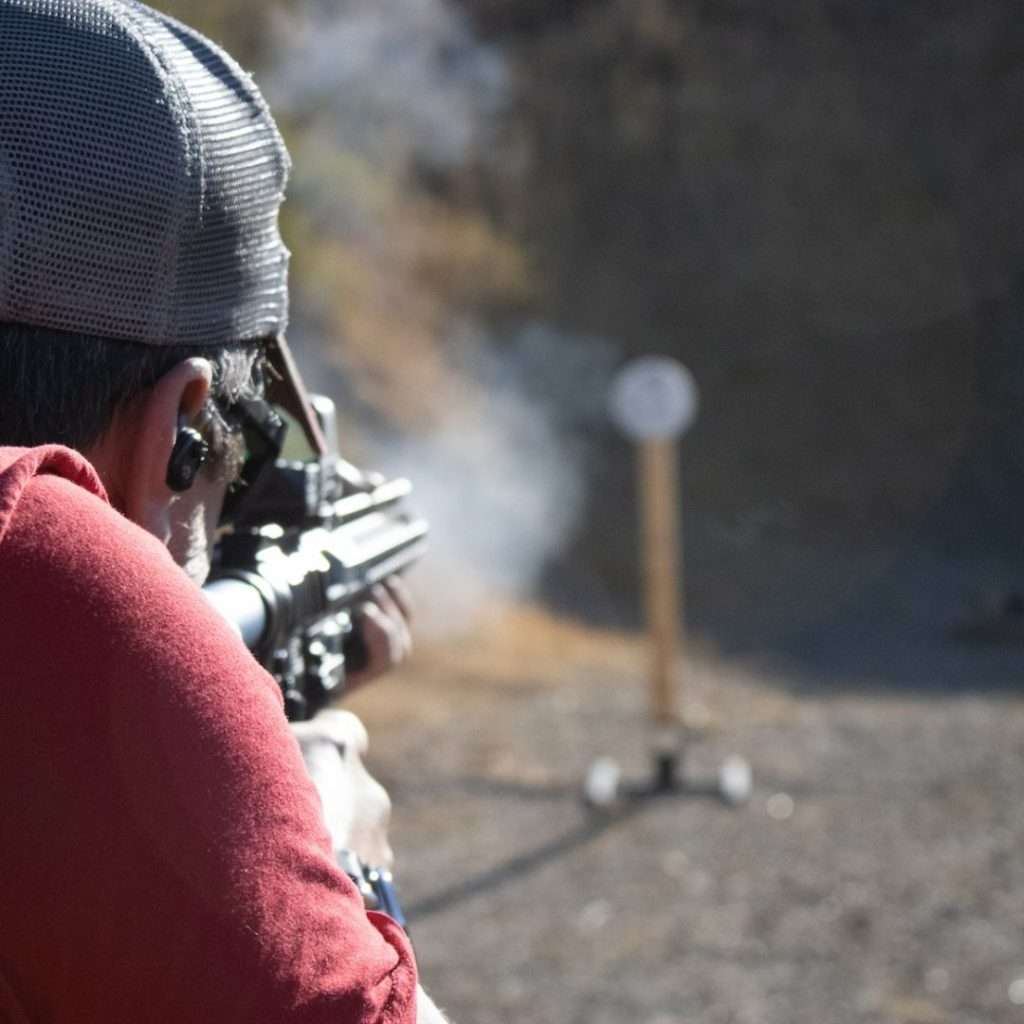
On this page
Smoke & Hope is the fastest stage in the sport and the one where the peak times sound impossible until you look at the layout. Four big rectangles, all close, all wide, and a stop plate straight up the middle. The name is not a joke — it is a description of the failure mode.
The official layout
Four 18″×24″ rectangles and one 12-inch stop plate. One 3′×3′ box. Five strings, best four counted.
Our own scale plan of SC-103 · Smoke & Hope, drawn from the dimensions published in Appendix B of the SCSA Competition Rules, edition 2026-03. Seen from above, shooting box at the left.
| Target | Size | Distance from the box | Offset from center | Height to top |
|---|---|---|---|---|
| 18″×24″ rectangle | 18 x 24 inches | 21 ft | 14 ft left | 5 ft 6 in |
| 18″×24″ rectangle | 18 x 24 inches | 21 ft | 14 ft right | 5 ft 6 in |
| 18″×24″ rectangle | 18 x 24 inches | 27 ft | 9 ft left | 5 ft 6 in |
| 18″×24″ rectangle | 18 x 24 inches | 27 ft | 9 ft right | 5 ft 6 in |
| 12″ stop plate | 12 inches | 42 ft | on the center line | 5 ft |
What a 100% run looks like here
The stage peak is the aggregate of your 4 counted strings. Divide it by 4 and you get a par time you can set on a shot timer today.
| Division | Stage peak | Per string |
|---|---|---|
| Rimfire Rifle Optics | 7 s | 1.75 s |
| Rimfire Pistol Optics | 7 s | 1.75 s |
| PCC Optics | 7 s | 1.75 s |
| Open | 8.5 s | 2.12 s |
| Carry Optics | 10 s | 2.50 s |
| Production | 10 s | 2.50 s |
| Single Stack | 10.25 s | 2.56 s |
| Iron Sight Revolver | 10.5 s | 2.62 s |
Peak times verified against SCSA’s live classification system on September 8, 2026. The full 16-division table is on our peak times page.
Why it is the fastest stage
Every standard target is an 18-by-24-inch rectangle inside 27 feet. In Rimfire Rifle Optics and PCC Optics the stage peak is 7.00 seconds for four counted strings — 1.75 seconds per string, five targets. That is not a typo and it is not reserved for the national champion; it is the benchmark that a 100% run is measured against.
The targets are so forgiving that the stage stops being a shooting problem and becomes a pure gun-handling problem. Nothing here rewards a careful sight picture. Everything here rewards how fast your eyes get to the next target and how little the gun overshoots when it follows them.
How to shoot it
- Sweep one side to the other, then take the stop plate. Outer left, inner left, inner right, outer right — or the mirror — then straight up the middle. The stop plate is the only target on the center line, so it should be the only direction change you make.
- Look at the target, not the sight. On rectangles this size at this distance a hard visual focus on the target with a soft awareness of the dot is faster and just as accurate.
- Drive with your eyes. The gun follows where you are already looking. If your eyes and the gun arrive together, you are transitioning too slow.
- Respect the stop plate. It is 12 inches at 42 feet — by far the smallest and most distant target on the stage. This is the one stage where the stop plate is genuinely harder than the standard targets, and where hosing through the array and then throwing a shot at the stop plate is the classic blown run.
The common mistakes
- Going too fast at the stop plate. Everything before it is nearly free, so shooters carry that pace into a 12-inch plate at 14 yards and miss it. That miss is not three seconds — if you never connect, the string is 30.
- Zig-zagging the array. Near, far, near, far doubles the total sight travel for no benefit.
- Trying to aim. On a target this size at this distance, aiming is the slow way to do the same job.
The other seven stages
Same five targets, eight different problems. The full set, plus the data behind them:
- SC-101 · 5 to Go
- SC-102 · Showdown
- SC-104 · Outer Limits
- SC-105 · Accelerator
- SC-106 · Pendulum
- SC-107 · Speed Option
- SC-108 · Roundabout
- Peak times — every division, every stage
- Start here: the complete guide to Steel Challenge
Sources
SCSA Competition Rules, edition 2026-03, effective March 1, 2026 — Appendix B (stage diagrams), rule 2.1 (target height) and the chapters cited inline. Peak times from SCSA’s live classification system, retrieved September 8, 2026. The diagram above is our own drawing made from the published dimensions. If a measurement here does not match the stage as your club sets it, the rulebook and your match director are the authority — and we would like to know about it.
 Steel Challenge Roundabout (SC-108): Layout, Dimensions and Strategy
Sep 9, 2026
Steel Challenge Roundabout (SC-108): Layout, Dimensions and Strategy
Sep 9, 2026
 Steel Challenge Speed Option (SC-107): Layout, Dimensions and Strategy
Sep 9, 2026
Steel Challenge Speed Option (SC-107): Layout, Dimensions and Strategy
Sep 9, 2026
 Steel Challenge Pendulum (SC-106): Layout, Dimensions and Strategy
Sep 9, 2026
Steel Challenge Pendulum (SC-106): Layout, Dimensions and Strategy
Sep 9, 2026