
What you are looking at
This is the complete Steel Challenge peak-time table — all 16 scoring divisions across all 8 official stages. It is the number your match times get divided into to produce a classification percentage. SCSA publishes it inside the classification engine but not as a table anyone can read, and every third-party version we could find is between two and six years out of date.
Current as of September 8, 2026, verified against SCSA’s live classification system. SCSA’s classifications were last recalculated September 2, 2026.
A peak time is not a record and it is not a goal. It is a fixed benchmark per division, per stage.
Per the SCSA rulebook, peak stage times are an average of the 2014 and 2015 World Speed Shooting Championship stage winning times for each division, and SCSA may adjust them annually. That is why a Grand Master card in Carry Optics and a Grand Master card in Rimfire Rifle Optics represent very different raw clock speeds: each division is measured against its own benchmark.
Source: SCSA Competition Rules, edition 2026-03, Appendix A3 and Appendix A4. Table values retrieved from SCSA’s live classification system.
Every number below is a stage aggregate: the total of your best four strings out of five, except Outer Limits (SC-104), which is the best three out of four. Divisions are sorted fastest to slowest by total.
| Division | Code | SC-101 5 to Go |
SC-102 Showdown |
SC-103 Smoke & Hope |
SC-104 Outer Limits |
SC-105 Accelerator |
SC-106 Pendulum |
SC-107 Speed Option |
SC-108 Roundabout |
8-stage total |
|---|---|---|---|---|---|---|---|---|---|---|
| Rimfire Rifle Optics | RFRO | 9.5 | 7 | 7 | 10.75 | 8.5 | 9 | 9 | 7 | 67.75 |
| PCC Optics | PCCO | 9.5 | 7 | 7 | 11.25 | 8.75 | 9 | 9.5 | 7.5 | 69.5 |
| Rimfire Pistol Optics | RFPO | 8.75 | 7.5 | 7 | 11.5 | 8.5 | 9.5 | 10 | 7.5 | 70.25 |
| Rimfire Rifle Irons | RFRI | 9.75 | 7.5 | 7.5 | 12 | 9 | 9.75 | 10 | 7.5 | 73 |
| Rimfire Revolver Optics | RRO | 9.75 | 8.25 | 7.75 | 12.75 | 9.5 | 10.5 | 11 | 8.25 | 77.75 |
| PCC Irons | PCCI | 10.75 | 8.5 | 7.75 | 12.25 | 9.5 | 10.5 | 11 | 8 | 78.25 |
| Rimfire Pistol Irons | RFPI | 10.5 | 9 | 8 | 13 | 9.25 | 11 | 11 | 8.25 | 80 |
| Open | — | 11.25 | 9.5 | 8.5 | 12.5 | 10.5 | 11.25 | 11.5 | 8.5 | 83.5 |
| Rimfire Revolver Irons | RRI | 11.5 | 10 | 9 | 14.25 | 10.25 | 12 | 12 | 9 | 88 |
| Limited Optics | — | 12.25 | 9.5 | 9.5 | 13.5 | 10.75 | 12.25 | 12.25 | 9.5 | 89.5 |
| Limited | — | 12.5 | 9.5 | 9.5 | 13.5 | 10.5 | 12.5 | 12.5 | 9.5 | 90 |
| Carry Optics | — | 12.5 | 9.75 | 10 | 13.75 | 11 | 12.75 | 13 | 9.75 | 92.5 |
| Production | — | 13 | 10 | 10 | 14 | 11.5 | 13 | 13 | 10 | 94.5 |
| Optical Sight Revolver | OSR | 12.25 | 10.5 | 10 | 14.25 | 12.75 | 13.5 | 12.75 | 10.5 | 96.5 |
| Single Stack | — | 13.25 | 10.5 | 10.25 | 14.75 | 11.75 | 13.5 | 13.5 | 10.5 | 98 |
| Iron Sight Revolver | ISR | 13.5 | 12 | 10.5 | 15.75 | 13 | 14.25 | 14 | 11 | 104 |
Codes are the sub-division abbreviations printed in the rulebook appendices (D3, D6, D8, D9, D11). The rulebook does not assign a printed code to Open, Limited, Limited Optics, Production, Single Stack or Carry Optics, so we have left those blank rather than invent one. Peak times are the values SCSA’s classification engine was applying as of September 8, 2026, and can be revised annually.
The classification percentage is not “your time over the peak time.” It is the other way around, and it is summed across stages, not averaged per stage.
The formula
Your percentage = (total peak time for the stages you shot) ÷ (your total time for those stages).
Add up the peak times for every stage you have a score on. Add up your own aggregate times for those same stages. Divide the first by the second. That is your number.
Say you shoot all eight stages in Carry Optics. The peak total is 92.5 seconds. To hit each class, your eight-stage total has to come in at or under peak ÷ the class threshold:
| Class | Threshold | Your 8-stage total must be |
|---|---|---|
| D | 0% | Any finish |
| C | 40% | 231.25 s or faster |
| B | 60% | 154.17 s or faster |
| A | 75% | 123.33 s or faster |
| M | 85% | 108.82 s or faster |
| GM | 95% | 97.37 s or faster |
That reframes the whole thing. C class in Carry Optics is a 231-second eight-stage match — that is roughly 29 seconds a stage, or about seven seconds a string. A competent shooter who has never worn a timer is usually already there. B is 154 seconds, under five seconds a string. That is the first number that requires actual work.
Stage peak times are aggregates, which makes them hard to use at the range. Divide by four (or three, on Outer Limits) and you get a par time you can actually set on a timer.
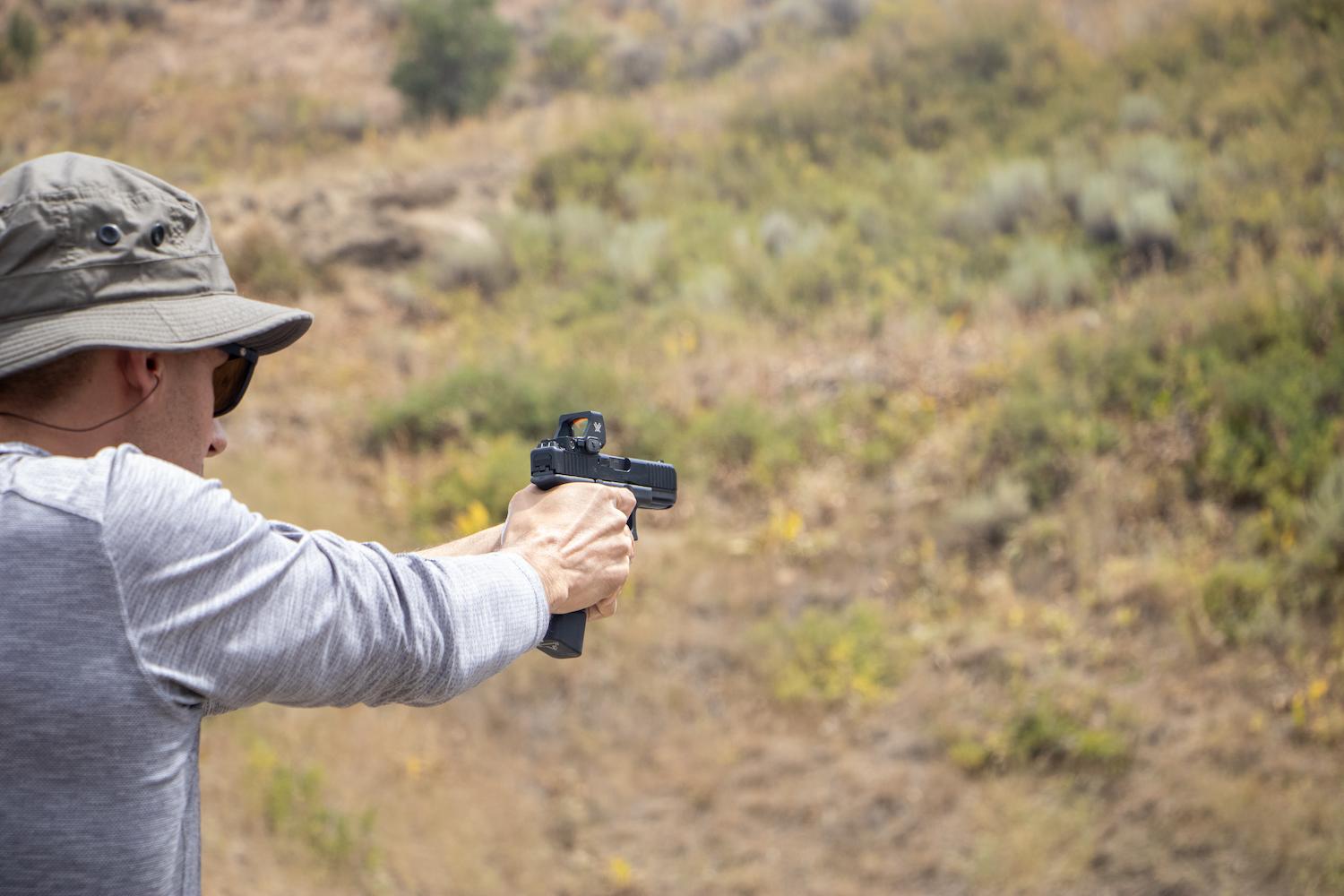
The benchmark is not a mystery. It is a par time you can set on a shot timer this afternoon.
Two examples, both at 100% — Grand Master pace and then some:
Set that as a par time, start from the real start position, and you learn very quickly which part of the run is costing you — the draw or point-in, the transitions, or the stop plate. For most shooters below A class it is the transitions, and it is not close. Pendulum is the stage that proves it: every plate is at the same distance, so the only variable left is how you move the gun.
Most of the seconds are in transitions and in what you can see, not in the gun. A clean dot, ammunition your gun actually likes, and something to shoot at in the off-season do more than anything else on the shelf.
Which division a gun actually lands in is a rulebook question, and the answer moved this year. The 2026 divisions page has all sixteen with the equipment rules that decide it.
Verified September 8, 2026 against SCSA’s live classification system, which had last recalculated on September 2, 2026. The update date at the top of this page is the real one — when we revise the table, we re-stamp it.
SCSA can adjust peak times annually and recalculates classifications every Wednesday, so treat any peak-time table anywhere — including this one — as a snapshot with a date on it. We review this page against SCSA’s live system on a regular cycle and update it when a number moves.
If you spot a value here that no longer matches your own classification record, tell us. Email [email protected] or mention it at the counter — we will check it against the source and correct it on the next review, and re-stamp the date when we do.
Sources
SCSA Competition Rules, edition 2026-03 (effective March 1, 2026), Appendix A3 and Appendix A4; SCSA classification system documentation and live classification records at scsa.org, retrieved September 8, 2026.