
The AR-15: A Modular Marvel
Two halves, two pins, and a lifetime of configurations. How the AR's gas system actually works, what barrel length costs you, and the Colorado rules that govern a build.

On this page
Nothing else in the sporting rifle world is quite like an AR-15. The genius of Eugene Stoner’s design isn’t the rifle itself — it’s that the rifle is really a toolkit. Swap uppers, change calibers, rearrange stocks, add optics, all without a gunsmith. That is the “modular” everyone talks about, and it’s why the platform stayed popular while dozens of other designs came and went.
Two Halves, One Rifle
- Lower receiver — the serialized part. Houses the trigger group, magazine well, grip and stock. This is what the ATF considers “the firearm.”
- Upper receiver — barrel, bolt carrier group, handguard, gas system, muzzle device. Not serialized under federal law.
- Two pins — a takedown pin and a pivot pin. That’s all that connects them.
We are not going to tell you how that applies to your particular pile of parts — that is a legal question, and an unsettled one in places. Read the SB25-003 guide, read the Dealer Division guidance it links, and take anything unusual to a Colorado firearms attorney.
01How the Action Works
The AR is gas-operated. When you pull the trigger, propellant gas from the fired cartridge is bled off through a small port in the barrel and routed rearward to cycle the action. There are two flavors:
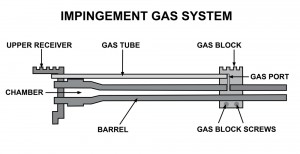
Direct Impingement
The Stoner original — and the name is a bit of a misnomer. Gas travels back through the tube, enters the carrier key, and expands inside a sealed chamber between the bolt tail and the carrier, driving the two apart. It’s an internal piston, not gas slapping the carrier face. Stoner made that distinction himself. Fewer moving parts, lighter, cheaper to build — but the gas ends up in the receiver, so it runs hotter and dirtier over long strings.
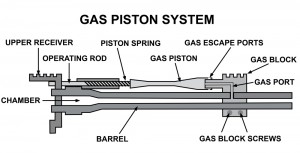
Piston Driven
A short-stroke or long-stroke piston isolates the gas up front. Cleaner running receiver, cooler bolt, better for suppressor use — at the cost of more weight, more complexity, and a bit more carrier tilt to design around. AK owners will recognize the layout.
02Barrel Choice Drives Everything
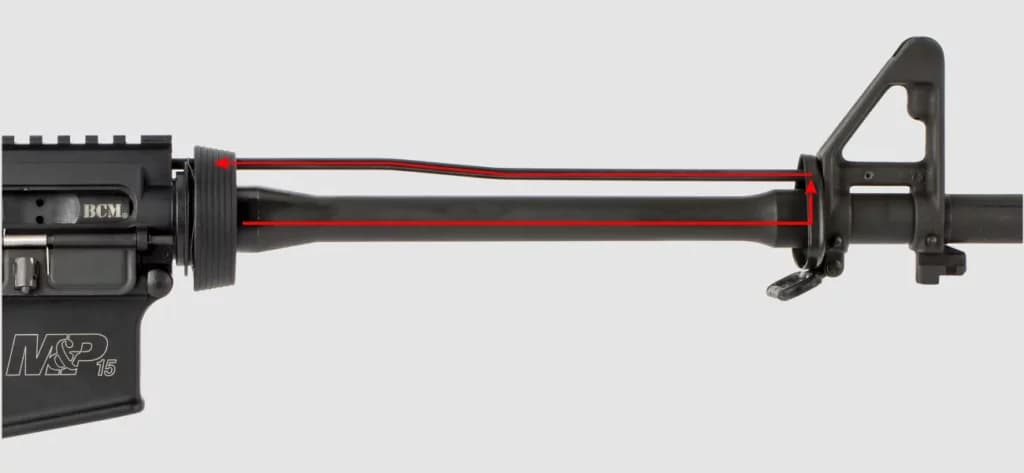
Barrel length is the single biggest handling and performance choice you’ll make on an AR:
- 10.5″ – 12.5″ — short-barreled rifles or AR pistols. Maneuverable indoors, loud, big muzzle flash. Against a 16″ barrel, expect to give up roughly 300–500 fps in 5.56 depending on the load — enough to matter for terminal performance at distance.
- 14.5″ — classic M4 length. Great compromise; usually pinned/welded to hit the 16″ minimum without an NFA stamp.
- 16″ — the federal-minimum rifle barrel. The most common civilian AR.
- 18″ – 20″ — the accuracy-first choice. Longer sight radius, higher velocity, cleaner burn.
03Calibers Beyond 5.56
The AR-15 was designed for 5.56 NATO/.223 Rem, but the platform is happy in a long list of chamberings. Because the magazine well and lower stay the same, you often just swap the upper to change calibers.
- 5.56 NATO / .223 Rem — the workhorse.
- .300 Blackout — short-barrel and suppressor-friendly, subsonic-capable.
- 6.5 Grendel / 6mm ARC — long-range and hunting.
- .224 Valkyrie — extended-range varminting and target work.
- .458 SOCOM / .450 Bushmaster — big-bore hunting.
- 9mm / other pistol calibers — PCC (pistol caliber carbine) variants.
For a bigger jump — think .308 Win / 6.5 Creedmoor — you’re looking at an AR-10, the platform’s larger sibling. Same operating principle, different-sized parts.
— Elk River Guns
04Optics & Sights
The flat-top upper’s Picatinny rail means you can mount almost anything. Match the optic to the mission:
- Red dot sights — 0–100 yards, both-eyes-open speed. Aimpoint, Holosun, Trijicon MRO.
- LPVO (low-power variable optic) — 1–6x, 1–8x, 1–10x. The do-it-all choice for hunters and competition shooters.
- Prism scopes — fixed magnification (usually 3x or 4x), etched reticle, works without a battery.
- Higher-power scopes — for varminting and long-range work on 18″+ barrels.
05Stocks, Grips, Rails & Accessories
Nothing on an AR is welded to your face. Try a heavier stock for precision, a lightweight collapsing stock for a truck gun, an angled foregrip for offhand work. Free-float handguards let the barrel harmonize without contact interference, which usually improves accuracy. Slings, weapon lights and pressure switches mount to M-LOK slots on essentially every current handguard. If you’re shopping used gear you’ll still run across KeyMod — it lost the standards fight around 2017 and accessory support has been drying up ever since, so don’t build a new rifle around it.
06Keep Reading — The AR Series

Build. Upgrade. Ask Questions.
1320 Dream Island Plaza • Steamboat Springs, CO 80487
We’ll treat you right.
Regulations cited: C.R.S. 18-12-116 (SB25-003) and the Colorado Firearms Dealer Division’s Specified Semiautomatic Firearms guidance; C.R.S. 18-12-301/302 (magazine capacity). Firearms law changes, and parts of SB25-003 are the subject of pending litigation. The statutes and the state’s own guidance are the authority; a qualified Colorado attorney is the right place for your specific situation. Nothing here is legal advice.
 AR-15 Versatility: Competition, Hunting and Home Defense
Sep 8, 2026
AR-15 Versatility: Competition, Hunting and Home Defense
Sep 8, 2026
 Introduction to AR-Type Rifles
Sep 8, 2026
Introduction to AR-Type Rifles
Sep 8, 2026
 AK Variants and Custom Mods: How to Tell Them Apart
Sep 8, 2026
AK Variants and Custom Mods: How to Tell Them Apart
Sep 8, 2026