
Introduction to AR-Type Rifles
What "AR" actually stands for, where Stoner's 1956 design came from, and how it became the best-selling centerfire rifle in America. Part 1 of 3.
On this page
The AR-15 is probably the most misunderstood rifle in America. Fans and critics alike toss around the term without knowing where it came from, what it stands for, or how it works. This piece is the starting point — the shop-counter answer to “so what actually is an AR?”
First: What “AR” Means
- “AR” stands for ArmaLite Rifle — the name of the company that developed it in the late 1950s.
- It does not stand for “assault rifle” or “automatic rifle.”
- The civilian AR-15 is a semi-automatic — one trigger pull, one round fired — not a machine gun.
01The Origin Story

ArmaLite was a small firearms division of the Fairchild Engine and Airplane Corporation. In 1956, their chief engineer Eugene Stoner unveiled the AR-10 — a lightweight, air-cooled, gas-operated 7.62 NATO battle rifle built with aircraft-grade aluminum and fiberglass. Radical for its time.
The AR-15 followed shortly after as a scaled-down variant in the new .223 Remington cartridge, later standardized as 5.56 NATO. The U.S. Air Force and Army adopted it in the early 1960s and renamed it the M16 for military service.
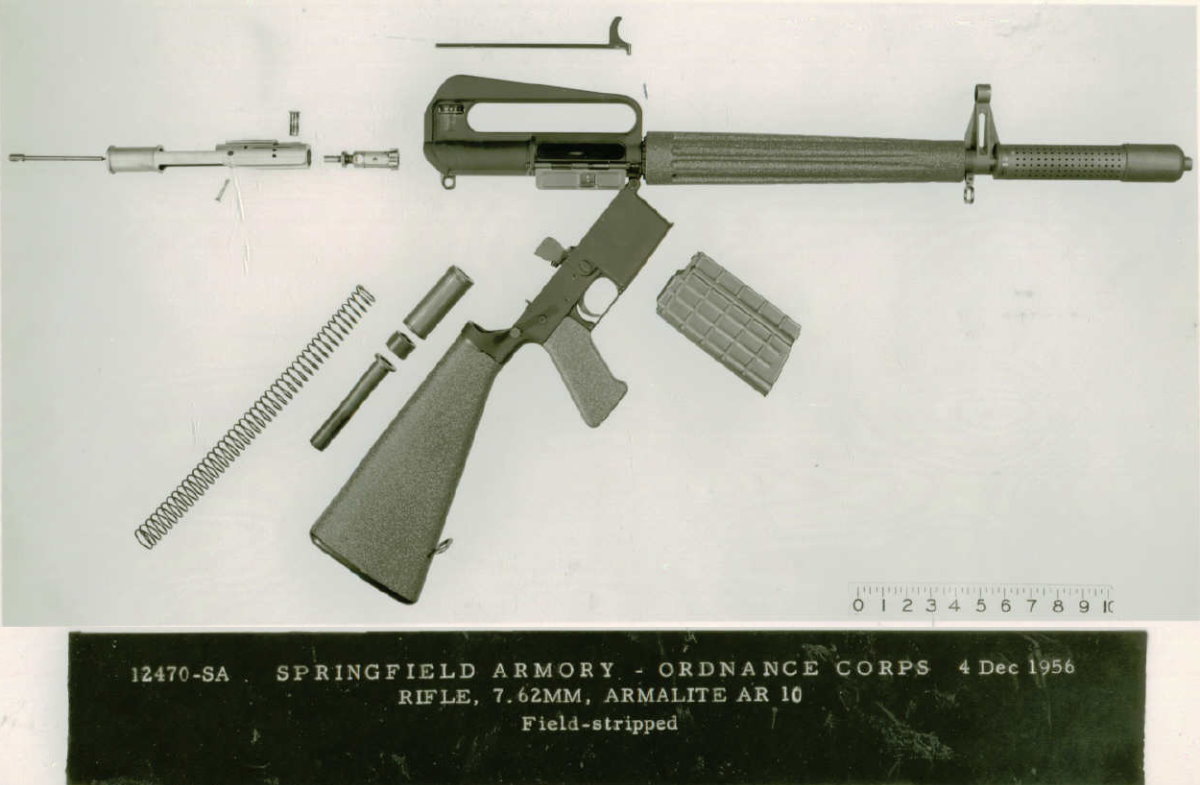
Eugene Stoner’s AR-10 prototype in 1956 — the direct ancestor of today’s AR-15.
02What Makes an AR an AR
Modern civilian AR-15s share the same architecture Stoner drew up: an aluminum upper and lower receiver that split at two takedown pins, a bolt carrier group riding a buffer spring in the buttstock, and a magazine well that feeds cartridges from below. The controls (magazine release, safety, bolt catch) sit where they always have. That consistency is why an AR-15 you buy in 2026 accepts parts made 30 years ago.
03Milestones in Evolution
- 1956 — Stoner’s AR-10 prototype fires for the first time.
- Late 1950s — ArmaLite scales the design down to .223 Rem, creating the AR-15.
- 1959 — ArmaLite sells rights to Colt, which begins commercial production.
- Early 1960s — U.S. military adopts the design as the M16.
- 1970s–80s — Civilian semi-auto AR-15 becomes a sporting and varmint-hunting mainstay.
- 1990s–2000s — Modularity explodes. Uppers, rails, optics, calibers — the platform becomes fully user-configurable.
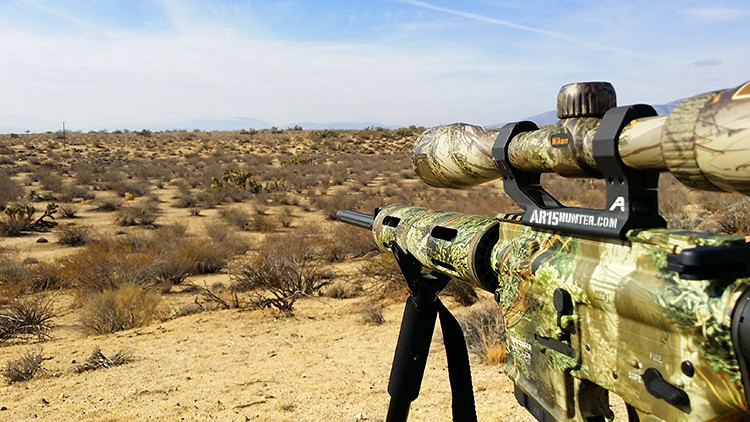
- Today — The AR-15 is the best-selling centerfire rifle format in America, used for competition, hunting, home defense and training.
04Why It Matters
Understanding what an AR-15 is — a decades-old, thoroughly civilianized, semi-automatic rifle built from a modular design — is the first step to using one responsibly. In parts two and three of this series we go under the hood on how it works and why it’s the most versatile long gun on the market.
05Keep Reading — The AR Series
Firearms laws change. Colorado’s SB25-003 introduced new requirements for certain semi-automatic firearms effective Aug. 1, 2026, and parts of it are the subject of pending litigation — check our SB25-003 guide and the statute itself before purchase. Nothing here is legal advice.
 AR-15 Versatility: Competition, Hunting and Home Defense
Sep 8, 2026
AR-15 Versatility: Competition, Hunting and Home Defense
Sep 8, 2026
 The AR-15: A Modular Marvel
Sep 8, 2026
The AR-15: A Modular Marvel
Sep 8, 2026
 AK Variants and Custom Mods: How to Tell Them Apart
Sep 8, 2026
AK Variants and Custom Mods: How to Tell Them Apart
Sep 8, 2026