$4,500.00
Only 1 left in stock
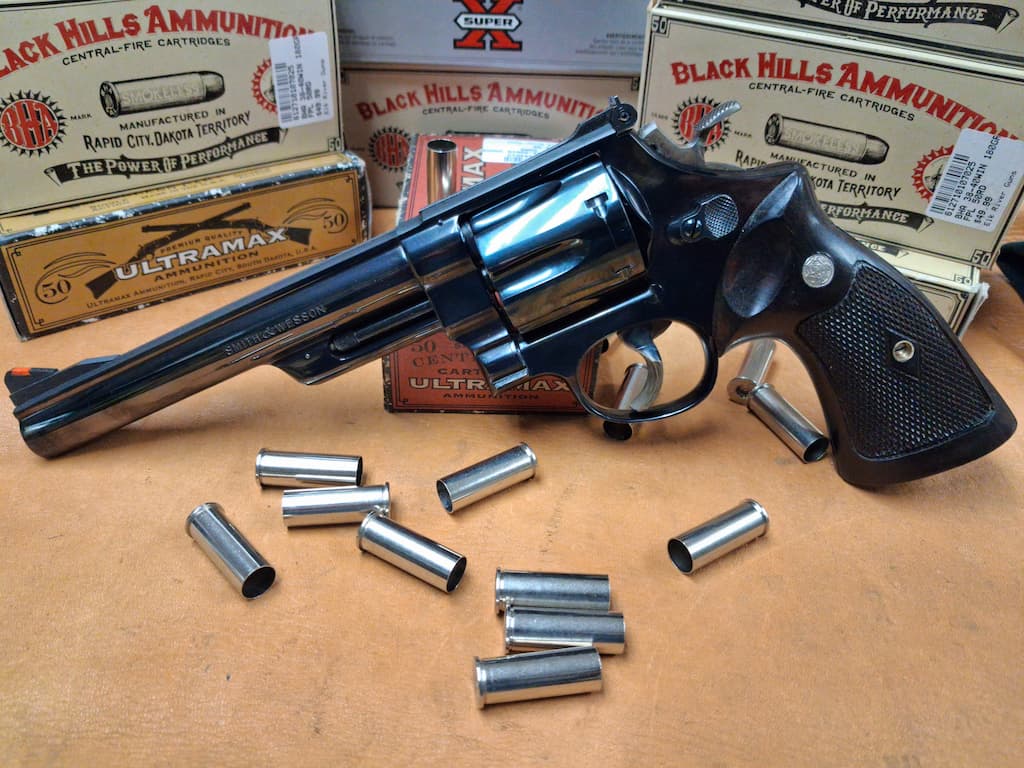
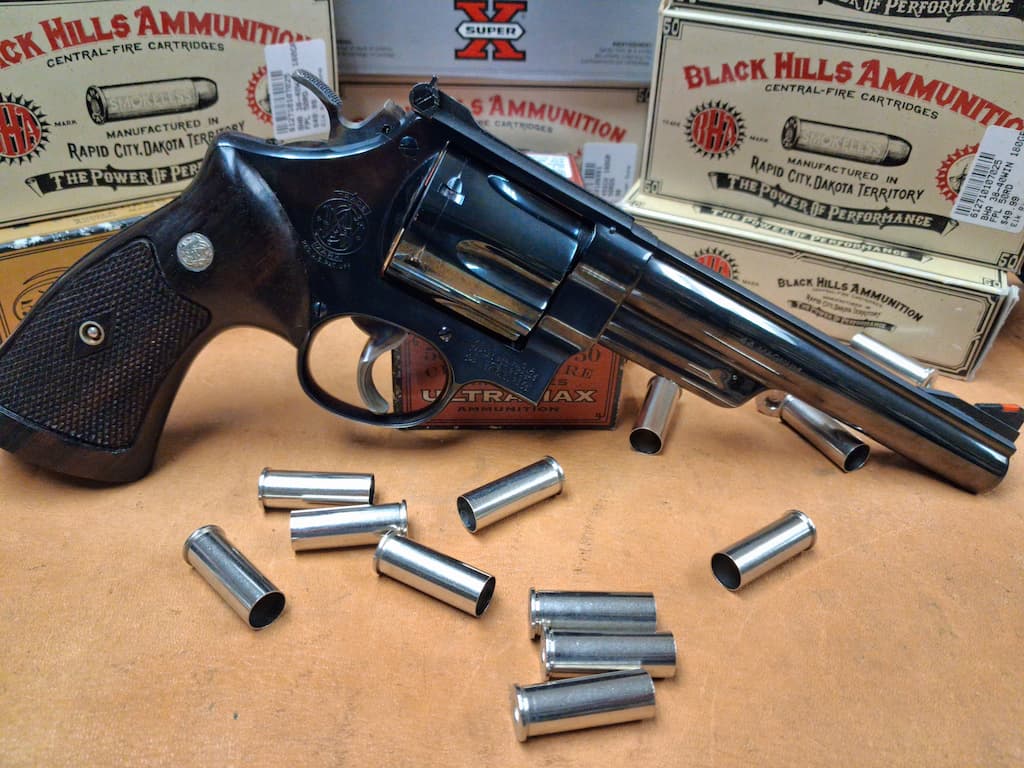
A first-year 1956 example of Smith & Wesson’s most historically significant revolver — built on the original 5-screw N-frame, 6½″ pinned blued barrel, recessed cylinder, with the original period-correct black leatherette presentation case and a Smith & Wesson Historical Foundation factory letter under serial S165753. Immaculate condition. The .44 Magnum cartridge was announced to the public on January 19, 1956 at $140 retail; this gun is part of that small first-year cohort that introduced the most powerful production handgun the world had ever seen. A documented, lettered, cased first-year Pre-29 is one of the most collectible American revolvers a serious shooter or collector can own.
Smith & Wesson completed the first production .44 Magnum revolver on December 15, 1955 (serial S130927, shipped to Walter Sanborn in the S&W Sales Department to develop the advertising campaign). Serial S130806 went to R.H. Coleman at Remington Arms on December 29. The .44 Magnum cartridge was officially announced to the public January 19, 1956, at $140 retail — roughly $1,700 in today’s dollars. [Wikipedia: .44 Magnum]
What followed was the cartridge that would, fifteen years later, become a household name through Dirty Harry, and the gun design that — through various generations — would remain in continuous S&W production for 43 years.
This revolver is part of that small first-year cohort. Serial S165753, manufactured 1956, with a Smith & Wesson Historical Foundation factory letter and the original period-correct presentation case. A documented, lettered, cased first-year Pre-29 in immaculate condition is one of the most collectible American revolvers a serious collector or shooter can own.
The Pre-Model 29 is the era of S&W’s .44 Magnum before the factory began stamping “MODEL 29” on the frame — a designation that didn’t appear until the second half of 1957. Across the entire pre-stamping era, S&W built only about 6,500 Pre-Model 29 revolvers on the 5-screw N-frame. The first-year (1956) examples are the most desirable subset of an already-collectible series. [American Rifleman]
The collector wisdom is straightforward: “The early Model 29s from before 1958 are what collectors really want. Collectors and shooters alike are deeply passionate about the early ‘Pre-Model 29’ .44 Magnum N-frames… the early revolvers sell for double or triple what a later sample brings.” [S&W Forum: best Model 29 variants]
This gun carries all of the design hallmarks that define early N-frame .44 Magnum collecting:
The revolver is accompanied by a Smith & Wesson Historical Foundation factory letter for serial S165753, documenting the original 1956 ship date and as-configured specifications. Historical Foundation letters are the gold standard of provenance documentation for collectible S&W revolvers — they confirm a gun’s original configuration from S&W’s own records, signed by the company historian.
S&W charges $50 for these letters with an 8–12 week turnaround. The S165753 letter is in hand and ships with the gun. No wait, no risk of S&W records being incomplete.
(If buyer would like to see the letter scanned prior to purchase, please contact us — we are happy to email a full scan.)
The gun ships in its original factory presentation case — the correct, period-appropriate black leatherette-covered cardboard case that S&W used through 1957.
This case detail matters more than most buyers realize. S&W did not introduce the first mahogany Type 1 presentation cases until late 1958; those were used sparingly through May 1960 before being replaced by the Type 2 mahogany clamshell that most collectors picture. A mahogany case on a 1956 Pre-29 is wrong — the gun would have shipped in the black leatherette case you see with this one. Substituting a later, “nicer-looking” mahogany case (or a reproduction) would be a value-destroying mistake on a first-year gun. [S&W Forum: Type 1 mahogany case timing]
| Manufacturer | Smith & Wesson, Springfield, Massachusetts |
|---|---|
| Model designation | Pre-Model 29 (built before official Model 29 stamping began in mid-1957) |
| Serial number | S165753 |
| Year of manufacture | 1956 (first year of production) |
| Frame | N-frame, 5-screw configuration (four sideplate screws plus trigger guard screw) |
| Caliber | .44 Remington Magnum (cylinder also accepts .44 Special) |
| Capacity | 6 rounds |
| Action | Double action / single action |
| Barrel length | 6½ inches (standard catalog configuration) |
| Barrel features | Pinned barrel, ribbed profile |
| Cylinder | Recessed (countersunk chamber rims) |
| Finish | Factory blue (original) |
| Front sight | Ramp, factory |
| Rear sight | Adjustable target |
| Stocks | Checkered S&W factory stocks |
| Condition rating | Immaculate |
| Provenance | S&W Historical Foundation factory letter + original presentation case |
The story of how this gun came to exist is one of the great chapters of American firearms history.
Through the 1920s, 30s, and 40s, writer and hunting guide Elmer Keith spent years pushing the .44 Special cartridge to its limits with heavy bullets and stout powder charges. His experiments — sometimes in custom revolvers, sometimes in production guns held together more by tradition than engineering — proved that a longer, stronger case could safely contain much higher pressures and deliver true hunting performance from a revolver. [RIA: Elmer Keith and the .44 Magnum]
In the early 1950s Keith made the pitch to Smith & Wesson president Carl Hellstrom and Remington Arms. Hellstrom is reported to have told Keith at the S&W plant that he “could wrap a fine gun around any load Remington would produce.” Remington engineered a new case — 0.125″ longer than the .44 Special, both to safely contain the much higher pressures and to prevent accidental chambering of the magnum round in older, weaker .44 Special revolvers — and S&W built the N-frame revolver around it.
The first production gun was completed December 15, 1955 (serial S130927, to Walter Sanborn in the S&W Sales Department to develop the advertising). The cartridge was announced to the public January 19, 1956. The Model 29 designation itself wouldn’t come until mid-1957. [.44 Magnum history]
One sidebar of trivia worth knowing: Sturm Ruger actually beat S&W to market with the .44 Magnum cartridge by several months in 1956. Ruger, working from publicly available cartridge data and a leaked specimen, brought out the .44 Magnum Blackhawk single-action before the gun S&W designed the cartridge for could ship in volume. Both guns are foundational, but the S&W is the one Keith and Hellstrom and Remington designed the whole project around.
S165753 is a part of that first-year story. A gun built when S&W’s customers were still discovering what the cartridge could do, when “magnum revolver” still meant something new and uncertain, and when no one yet knew that fifteen years later Clint Eastwood would make the Model 29 the most famous handgun in the world.
Fifteen years after this gun was built, the .44 Magnum N-frame — by then officially called the Model 29 — became the most famous handgun in American cinema. John Milius’s original Dirty Harry script (September 23, 1970 draft) specified a 4-inch nickel Model 29. The configuration was already so rare that S&W — working directly with Warner Bros. through factory rep Bob Sauer — had to assemble two guns from spare parts at the plant just to supply the production, and the only parts on hand were 6½″ blued. Eastwood’s screen gun is a 6½″ blued Model 29 cobbled together from parts. [IMFDB: Dirty Harry]
S165753 is the same N-frame design Eastwood carried — built fifteen years earlier, in the first year of production, in the standard 6½″ configuration that the studio ended up filming with anyway.
Blue Book baseline for a 5-screw Pre-29 (blued) runs from approximately $1,550 (80%) to $2,500 (100%). [Blue Book] Those baseline figures do not assume a factory letter, do not assume an original presentation case, and do not assume first-year manufacture — all three of which compound for serious collectors.
Direct realized comp: LSB Auctions sold a first-year 1956 5-screw Pre-29 with 6½″ barrel and presentation case for $6,545. [LSB Auctions]
General market reference: truegunvalue’s 2026 update places the average used 5-screw Pre-29 in the $2,500–$4,000 range; first-year letter-documented examples in immaculate condition trade above that, as the LSB realized comp confirms. [Cash for Arms 2026 update]
Asking: $4,500. A factory-lettered, original-case, immaculate first-year 1956 Pre-29 with a properly documented provenance is rarer than a typical Blue Book entry suggests, and positioned below the LSB realized comp for a like example. Hard to fault as a buy.
A 1956 Pre-29 is a piece of American firearms history. It is a first-year example of the gun that introduced the most powerful production handgun cartridge in the world at the time it was sold — the cartridge that Elmer Keith spent decades arguing for, that Carl Hellstrom and Remington built around his ideas, that Walter Sanborn took to market in advertising, that Bill Jordan and a generation of working lawmen learned to respect, and that eventually became the cartridge of cinema’s most famous revolver.
The .44 Magnum has been in continuous production in one variant or another for nearly 70 years. Of those, the first year (1956) is the smallest cohort, the most desirable, and the one with the strongest correlation between condition and price. This one is immaculate, lettered, cased, and properly preserved.
Ships to your FFL. Colorado residents may pick up in-store at our Steamboat Springs location. Call (970) 879-2210 or contact us with any questions. We’re happy to scan the factory letter for serious buyers prior to purchase and to send additional close-up photos on request.
Primary documentation (in our possession, available for inspection)
Editorial / historical
Collector authority
Books standard to S&W collecting
Valuation references
| UPC | USEDREVOLVER |
|---|---|
| Availability | In Steamboat Now |